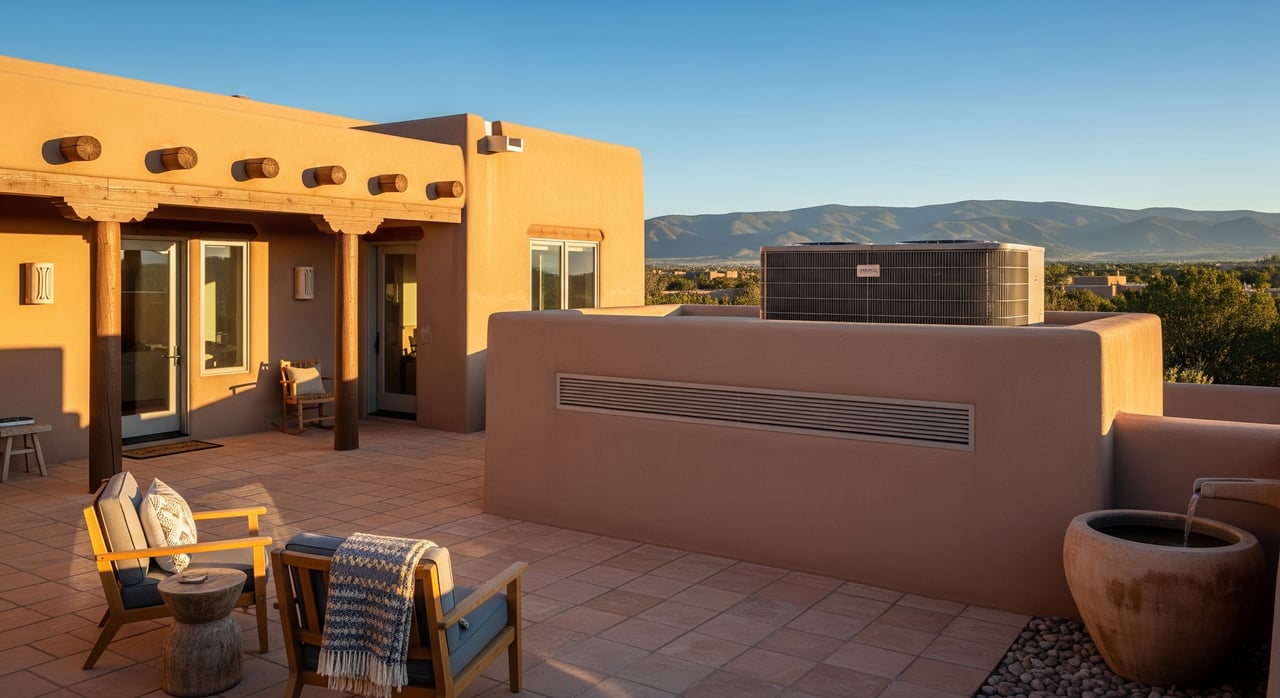
Trying to choose between evaporative (swamp) cooling and refrigerated AC for your Nambe home? You are not alone. Our high desert climate feels dry most of the year, then turns humid during the summer monsoon, which can change how each system performs. In this guide, you will see how each option handles Nambe’s weather, water use, smoke, and elevation so you can pick the right fit. Let’s dive in.
Nambe climate at a glance
Nambe sits in the high desert with hot days, cool nights, and a seasonal monsoon that raises humidity in summer. Santa Fe area data shows humidity is often low outside of July and August, when moisture peaks. That pattern is key because evaporative cooling works best on dry days. Local climate summaries describe these swings in detail.
Elevation also matters for equipment performance. Nambe and nearby areas sit around 6,000 feet and higher, which can affect how refrigerated systems are sized. See local elevation references for Nambe Pueblo and Santa Fe to understand the range. Topographic data for Nambe Pueblo is a helpful benchmark.
How each system works
Evaporative cooling
Evaporative coolers pull outdoor air through wet pads. As water evaporates, the air temperature drops and indoor humidity rises. The system needs a path for air to leave the home, such as slightly open windows or dedicated relief vents. Electricity use is low since there is no compressor. Learn the basics from Energy Saver’s evaporative cooler guide.
Refrigerated air conditioning
Refrigerated systems use a compressor to remove heat and moisture from indoor air, then reject heat outside. They cool reliably in both dry and humid weather and can dehumidify, which helps during monsoon season.
Pros and cons for Nambe
Evaporative cooling: where it shines
- Very low electricity use compared to AC
- Lower installation cost in many cases
- Brings in fresh outdoor air
- Works well on dry days typical of spring and fall
Evaporative cooling: key tradeoffs
- Loses effectiveness on humid monsoon days
- Adds indoor humidity
- Requires open windows or relief vents to work
- Uses water and needs seasonal maintenance
Refrigerated AC: where it shines
- Reliable cooling during humidity and heat waves
- Dehumidifies for better comfort in monsoon season
- Can run in recirculate for better filtration during smoke
- Works well in multi-room or tighter homes
Refrigerated AC: key tradeoffs
- Higher electricity use and typically higher install cost
- Requires altitude-aware sizing and sometimes high-altitude adjustments
Energy, water, and cost
Evaporative systems typically use a fraction of the electricity of refrigerated AC because they do not have a compressor. Energy Saver notes the energy advantage and the importance of proper ventilation and water supply. See Energy Saver’s overview for context.
Water matters in Northern New Mexico. For a 1,500 square foot Santa Fe home, the Building America Solution Center cites a rough estimate of about 3,000 gallons per cooling season for an evaporative unit without bleed-off. Actual use varies with hours and features like autoflush. Review the guidance and example figures from PNNL’s evaporative cooling resource.
Local conservation rules can affect your choice. The City of Santa Fe enforces time-of-day watering limits and other programs, which is a reminder to weigh water use in summer. Check current rules from the City of Santa Fe Water Conservation updates.
Indoor air and wildfire smoke
Evaporative coolers bring in continuous outdoor air. That is helpful for ventilation, but it can also draw in smoke during wildfire events. The EPA recommends avoiding evaporative cooling during heavy smoke unless you can filter or cover the intake. Refrigerated systems can run in recirculate with higher efficiency filters to reduce particle levels. Review EPA wildfire and indoor air guidance for practical steps.
Elevation and equipment sizing
At Nambe elevations, many manufacturers require derating or high-altitude kits for refrigerated equipment. A common rule of thumb is a capacity reduction at higher altitudes, which affects sizing and performance. Always ask installers to document how they accounted for elevation and to follow manufacturer guidance. An example of altitude notes appears in a Rheem installation manual.
Quick decision guide
Choose evaporative cooling if all apply
- Your home’s cooling season is mostly dry with humidity well under about 50 percent
- You can provide relief openings or have ducting designed for airflow
- Water use fits your household budget and local rules
- You will maintain pads, pans, and winterize, and limit use during smoke events
Sources: Energy Saver on evaporative cooling, Santa Fe climate patterns, City water conservation updates.
Prefer refrigerated or hybrid if any apply
- You want reliable comfort during humid monsoon days or heat waves
- You need strong filtration for smoke or allergies, or you want humidity control
- Your floor plan makes continuous air relief impractical
- You are concerned about long-term water availability or cost
Sources: Energy Saver, EPA wildfire guidance, PNNL water-use examples.
Smart alternatives to consider
- Two-stage or indirect evaporative systems. These can pre-cool without adding as much humidity and may be paired with refrigerated backup. See an overview of designs in the evaporative cooler reference.
- Ductless mini-split heat pumps. These are efficient refrigerated systems with zoning and dehumidification that retrofit well. Ask for altitude-aware sizing based on manufacturer guidance.
Operation tips for Nambe homes
- During wildfire smoke: close or cover evaporative intakes with exterior filters and run refrigerated AC on recirculate with a high-MERV filter. Guidance from the EPA on smoke and indoor air is a helpful checklist.
- During monsoon days: expect evaporative performance to drop. Use refrigerated cooling or plan around the humidity.
- Water conservation: before summer, review the City of Santa Fe water rules and estimate seasonal water use with PNNL’s examples.
Choosing the right system in Nambe comes down to how you prioritize energy, water, indoor air, and day-to-day reliability in our high desert. If you want help weighing these tradeoffs as you plan improvements or prepare a home for sale or purchase, reach out to Jessica Hoffer for local, concierge-level guidance.
FAQs
Will a swamp cooler work in Nambe’s climate?
- Yes. It can work well on dry days common in spring and fall, but it loses effectiveness during the humid monsoon period and uses water. See local climate patterns from Weather-us.
How much water does an evaporative cooler use in Santa Fe County?
- PNNL cites about 3,000 gallons per season for a 1,500 square foot Santa Fe home without bleed-off, with higher use for longer run times or autoflush. See PNNL guidance.
Which costs less to run in Nambe: swamp cooler or AC?
- Evaporative coolers typically use about a quarter of the electricity of refrigerated AC, but you should also factor water cost, maintenance, humidity comfort, and smoke season. See Energy Saver.
Does Nambe’s elevation affect AC selection?
- Yes. Many manufacturers require derating or high-altitude kits above about 2,000 feet, so at roughly 6,000 feet you should ask installers to size and specify equipment for altitude. See this Rheem manual example.
What should I run during wildfire smoke in Northern New Mexico?
- Use refrigerated AC on recirculate with a high-efficiency filter and avoid operating evaporative coolers unless the intake is filtered or covered. Follow the EPA’s smoke and indoor air steps.