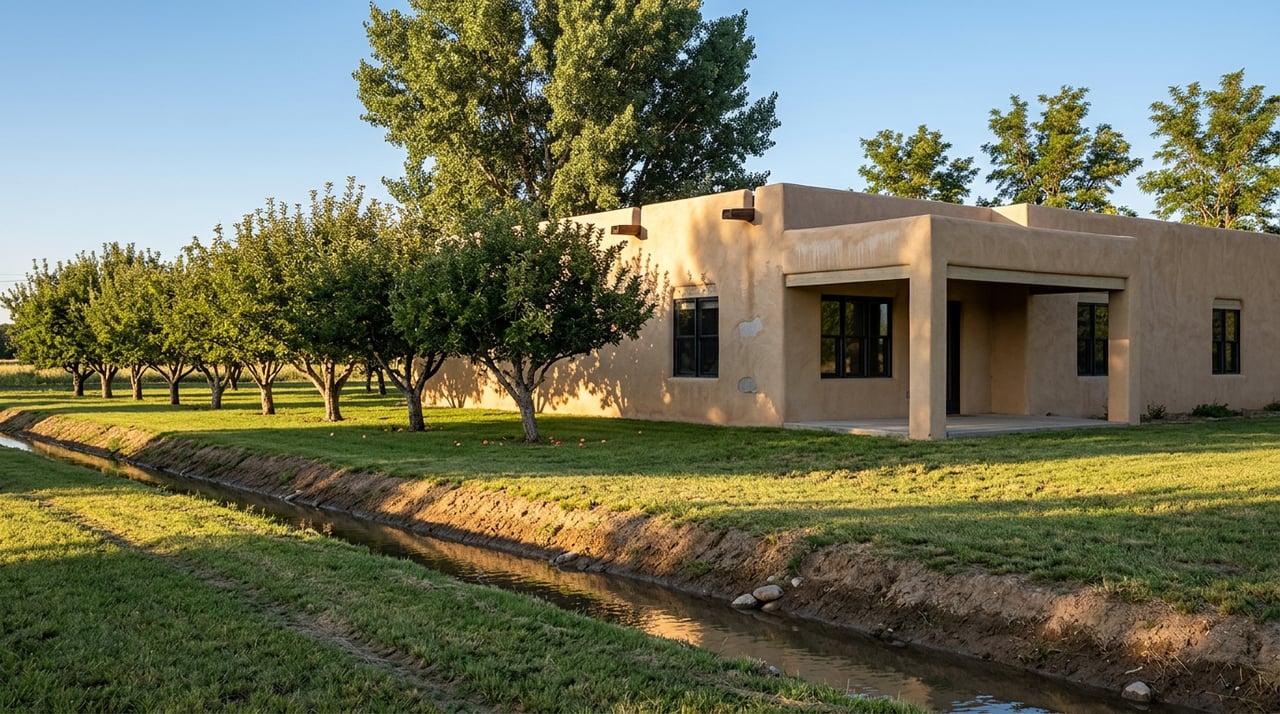
Two three-bedroom adobes go on the market in Nambe the same week, both around 2,000 square feet, both priced in the low $500s. One listing mentions "0.98 acres of irrigation rights and an acequia running along the west boundary." The other says "private well, metered." A buyer comparing them on price per square foot would call it a coin flip. It isn't. One of those homes is sitting on an asset that predates the town itself. According to Santa Fe County, connecting to the county water system is an opt-in decision for a buyer considering the private-well property, with connection costs and a sign-up deadline to consider.
That gap is the story in Nambe right now, and it has almost nothing to do with the number on the sign.
Why Every Nambe Listing Talks About Water Before It Talks About Bedrooms
Drive through Nambe and the difference from the surrounding valley is visible before you read a single listing. The Nambe River runs most of the year while other streams in the Pojoaque area go dry for stretches, a distinction locals bring up unprompted because it explains why the valley stays green when its neighbors don't. That isn't luck. Nambe sits near the top of the Nambe-Pojoaque-Tesuque stream system.
According to Santa Fe County, the Aamodt case is a water rights adjudication the state filed in 1966 that became one of the longest-running cases in federal court. It settled who owns what water among the Pueblos of Nambe, Pojoaque, San Ildefonso, and Tesuque and the non-Pueblo households who share the same river system. The court entered its final decree in July 2017, and the settlement it enforces makes one thing explicit: because the Pueblos' water use predates recorded history, their rights are senior. Everyone else's well is junior by comparison.
Seniority isn't just a legal abstraction. It's why a listing's acre-feet figure matters more than its acreage. Acre-feet and priority dates are details that can distinguish one water-right listing from another. A property with irrigation rights and a documented priority date may stand out from one running on a private well with no acequia history.
The Part of the Settlement That's Under Construction Right Now
None of this is settled history. It's an active construction project.
The Pojoaque Basin Regional Water System, the infrastructure piece of the Aamodt settlement, is a joint effort between Santa Fe County, the State of New Mexico, the U.S. Department of the Interior, and the four Pueblos to pipe treated Rio Grande water to both Pueblo and non-Pueblo households across the basin. The Santa Fe New Mexican reported that Phase 1 is targeted for completion in the first quarter of 2027. Phase 2, which brings transmission and distribution lines into Nambe, Pojoaque, and Tesuque directly, is scheduled for 2028. The same December 2025 report said crews were expected to begin work along Nambe Road, NM-503, within the following months, meaning the pipeline work has likely already reached Nambe directly rather than sitting somewhere downstream.
The project has also gotten expensive. The Bureau of Reclamation's cost ceiling was indexed at $734 million in October 2024, and at the escalation rate the county's own quarterly reporting uses, that figure was projected to reach roughly $777.5 million by 2026.
Here's where it becomes a buyer's problem and not just a civic one. Santa Fe County will cover up to $10,000 of the connection cost for households that file an acceptance form and opt in before Phase 3 of the project begins. Miss that window, and the same connection runs an estimated $8,000 to $12,000 out of pocket, paid entirely by the homeowner. As of December 2025, the county reported only about 300 non-Pueblo households between Espanola and Santa Fe had filed, against a goal of 1,100. That's a subsidized on-ramp that most of the eligible households in the basin hadn't taken yet as of that count.
The settlement also requires that non-Pueblo households who keep using their own wells install a meter. That's not a suggestion. It's a term of a federal settlement enforced through the same adjudication that decided who's senior and who's junior in the first place.
What a Buyer Is Actually Paying For
Put those two facts together, water rights and a subsidized connection window that's closing in phases, and the price spread in Nambe starts to make sense in a way square footage never explains it.
Typical homes in the valley run from roughly $375,000 to $575,000 depending on acreage and water rights. Properties with established horse stables, greenhouses, or larger irrigated lots run from $745,000 up to $1.2 million. That isn't necessarily just a stables premium. Water access can be part of the premium, too.
This is also why an acequia easement shows up as a line item worth asking about, not just a scenic detail. The New Mexico Attorney General's Acequia Association Governance Handbook describes acequia governance as giving ditch officials and cleaning crews a traditional right to cross private property to reach and maintain the ditch, even property a new owner didn't know was subject to that access. It's part of the same bundle that makes the water valuable in the first place. Buyers who treat "acequia water rights" as a landscaping feature are missing that it comes with a maintenance relationship attached to the land.
Questions Worth Asking Before You Write an Offer
A few specific things separate a Nambe property that's positioned well from one that's carrying a deferred decision:
- What is the acre-feet figure on the water right, and does the seller have documentation of its priority date?
- Is the property on a private well, a shared well, or acequia-fed irrigation, and is that well already metered under the settlement's requirements?
- Has the current owner filed an acceptance form or well election with Santa Fe County for the Pojoaque Basin Regional Water System, and if not, is that decision being left to the buyer?
- If the property will connect later, has anyone confirmed whether that will happen before or after Phase 3 begins, given the difference between a subsidized hookup and a full out-of-pocket one?
None of these show up in a standard listing sheet. They show up in county records, in conversations with the seller, and in knowing which questions to ask in the first place.
A Valley Worth the Extra Diligence
None of this is a reason to avoid Nambe. It's a farming village of around 1,200 people where the Nambe River still runs past the nearly century-old Sacred Heart Church, where the High Road to Taos cuts through the center of town, and where residents still hike up to Nambe Falls the way people here have for generations. The Poeh Cultural Center and Museum sits nearby telling that longer history, and Pojoaque Supermarket and the Sopaipilla Factory are a short drive south for anyone who'd rather not cook. It's twenty minutes from Santa Fe and Los Alamos both, which is exactly why it draws commuters willing to trade square footage in town for acreage and quiet.
The point is narrower than "buy here" or "don't." It's that the number on the sign was never the whole price. In Nambe, water-right details are part of the questions a buyer should ask about a property. Connecting to the county water system is a separate, opt-in decision with its own closing window. A buyer who asks about acre-feet and acceptance forms before falling in love with the vigas is negotiating from a position the other buyer touring the same open house doesn't have.
If you're weighing a property in Nambe or anywhere else in Northern New Mexico's patchwork of water rights and stream systems, that's exactly the kind of due diligence Jessica Hoffer walks clients through before an offer goes in, not after. Reach out to schedule a consultation, and bring your questions about the water right along with your questions about the house.
Frequently Asked Questions
Does every property in Nambe have water rights? No. Some lots rely on shared community wells through Nambe Pueblo rather than a private well or acequia allocation, and not every parcel carries an irrigation right. The type of water access varies lot by lot, which is exactly why it needs to be confirmed rather than assumed.
Is the Pojoaque Basin Regional Water System mandatory? Connection is opt-in for non-Pueblo households, based on filed acceptance forms or well elections with Santa Fe County. What is not optional, under the Aamodt settlement's terms, is metering for households that continue relying on their own wells.
Can water rights be transferred separately from the house? Whether a specific right conveys with a sale should be confirmed in the purchase documents, not assumed from the listing description alone.
This article is general information, not legal, tax or financial advice. Consult a qualified professional about your situation.